India’s management education landscape is undergoing a structural transformation. The MBA
is no
longer viewed only as a qualification for corporate roles — it is increasingly becoming a
career
transition tool, a leadership development pathway, and a professional acceleration platform for
individuals across sectors. As organisations move toward digital operations, data-driven
decision-making, and cross-functional leadership models, the demand for structured business
education continues to rise — but the format of learning is changing.
This is where flexible MBA formats such as open & distance education are reshaping access to
management education. Learners today are seeking recognised, credible degrees that allow them to
learn without exiting the workforce, while still building strategic, managerial, and leadership
capability. In this evolving context, institutions like Sambalpur University are expanding
access to management education through structured, recognised digital learning pathways.
Understanding how an open & distance learning MBA functions — its structure, recognition,
subjects, duration, and career relevance — becomes essential for learners making long-term
professional decisions.
It is a postgraduate management degree designed for learners who are unable to pursue
conventional full-time, on-campus programs but still seek structured academic training in
business and management disciplines. The model is built around guided self-learning, digital
academic delivery, scheduled assessments, and institutional academic support systems.
This format is especially relevant in today’s employment environment, where professionals
prioritise:
Rather than focusing only on theoretical instruction, modern distance MBAs emphasise applied learning, functional understanding, and strategic thinking — preparing learners for managerial roles across evolving sectors.
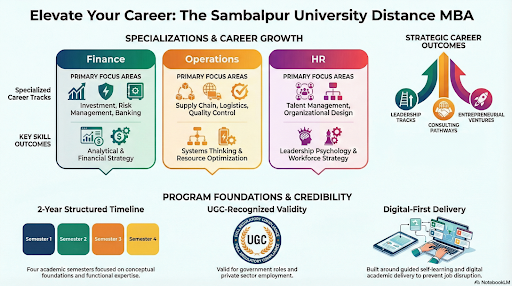
The standard MBA duration in India is two years, structured across four academic semesters. This
timeline remains consistent across learning formats — whether campus-based, distance, or
online.
However, modern learners increasingly approach MBA timelines strategically:
The two-year structure allows sufficient time for:
This ensures the degree is not merely academic, but professionally transformational.
One of the most critical decision factors for learners today is MBA recognition UGC compliance.
Any MBA program must align with national regulatory frameworks to ensure long-term validity,
career acceptance, and institutional credibility.
A recognised MBA must have:
This recognition ensures the degree is valid for:
Without regulatory recognition, the value of the qualification becomes limited in long-term career planning.
The management education ecosystem in India now offers multiple structured learning pathways,
allowing learners to choose based on career stage, life commitments, and professional goals.
Learning Formats Include:
Understanding how to apply for a distance MBA involves reviewing:
This flexible ecosystem allows learners to access management education without geographical or professional disruption.
State universities play a crucial role in democratising access to management education. Their programs are often built around:
The emergence of digital programs such as the SUV ODL MBA reflects this shift in public
education delivery models.
An MBA in Sambalpur
University represents this evolution, where state universities are extending
structured management education through digital platforms while maintaining regulatory integrity
and academic structure.
This model allows learners to access recognised degrees from public institutions without
relocating or exiting employment.
Understanding what are the courses in MBA helps learners assess long-term relevance and skill
outcomes. MBA curricula are designed to build layered competence across business functions.
Core Academic Areas Typically Include:
Alongside this, MBA specialisations allow learners to build depth in specific functional domains aligned with career trajectories and industry demand.
Understanding what are the subjects in MBA
Finance is essential for learners targeting
leadership roles in financial decision-making, corporate strategy, and organisational
planning.
Core Finance Learning Areas:
Finance specialisation develops:
This prepares learners for leadership roles in financial management and strategic planning functions.
Understanding what are
Operations in MBA helps learners see how business systems function beyond
theory. Operations management focuses on the design, efficiency, and optimisation of
organisational processes.
Operations Learning Areas Include:
Operations specialisation develops:
These skills are essential in manufacturing, services, logistics, healthcare, infrastructure, and technology-driven enterprises.
Human capital is now a strategic business function. Organisations increasingly require HR
professionals who understand leadership psychology, organisational systems, and workforce
strategy.
Career Scope Includes:
When learners explore MBA HR salary, they are evaluating not just income, but career scalability. HR leadership roles today extend into:
How much do MBA HR make? Earnings grow with:
The right age to do an MBA is no longer fixed. In modern career planning:
The question after MBA, what to do is increasingly answered through:
An MBA is no longer a terminal degree — it is a career mobility platform.
As industries digitise, learning ecosystems are evolving. Distance and digital MBAs are no longer considered secondary formats — they are becoming mainstream professional education models, especially for:
This transformation reflects a larger shift where skills, competence, and capability matter more than physical learning format.
A distance MBA is a postgraduate management degree delivered through structured off-campus academic systems, allowing learners to pursue business education without attending regular on-campus classes.
Subjects typically include financial accounting, corporate finance, investment analysis, risk management, financial markets, banking systems, and strategic financial management.
An MBA program should be UGC-recognised and institutionally approved to ensure academic validity, professional acceptance, and long-term career credibility.
The standard MBA duration in India is two years, structured across four academic semesters.
MBA HR graduates’ earnings vary based on role, sector, experience, and organisational responsibility. Growth is driven by leadership scope and strategic contribution rather than entry-level positions alone.
Operations electives commonly include supply chain management, logistics, quality management, project management, production planning, and process optimisation.
After an MBA, learners can pursue leadership roles, functional specialisations, entrepreneurial ventures, consulting careers, strategic roles, or organisational leadership tracks.
Yes. A UGC-recognised distance MBA is valid for employment across sectors, provided it meets regulatory and institutional recognition standards.
Modern MBA education is no longer defined by location — it is defined by learning quality,
regulatory recognition, skill relevance, and career impact. As industries evolve, learners
require flexible, credible pathways that build leadership capacity without disrupting
professional growth.
Distance and digital MBAs, when structured within recognised public university frameworks, offer
a future-aligned model of management education — combining academic depth, professional
relevance, and career scalability.
In today’s workforce economy, the MBA is not just a degree. It is a career design tool, a
leadership foundation, and a long-term professional investment.
Our counselling team is ready to assist you at every step — click the button below to get started.
Need advice? Our experts are on WhatsApp 24/7—message us anytime!